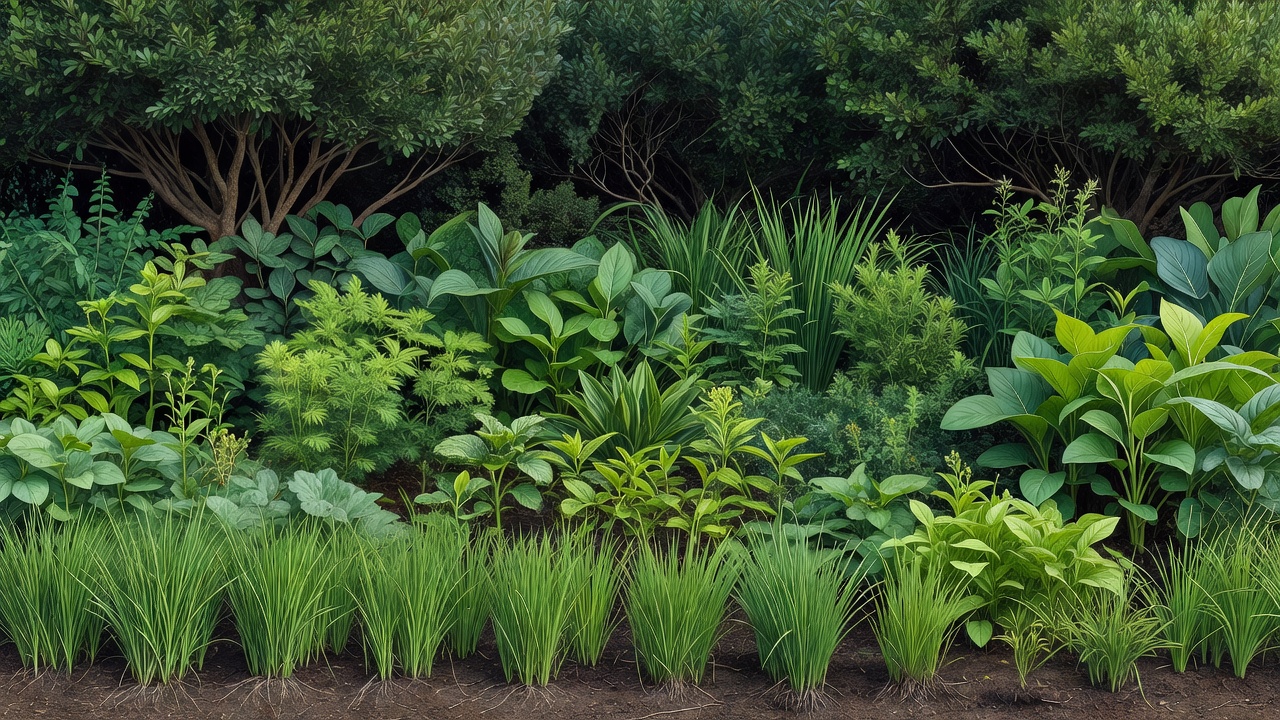
Separate establishment from display
A border can look full for a few weeks without being well established. Large plants brought in for an immediate display, annual fillers and tightly packed nursery stock can all create a convincing “after.” That appearance is not the same as a stable planting community suited to the soil and climate. A useful record identifies starting plant sizes and explains any temporary additions.
Take a broad photograph at installation and keep a planting list with positions. Record species or cultivars where known, rather than relying on flower colour to identify them later. Photograph labels separately before removing them from the bed. Include the soil surface, mulch and visible gaps. Those details provide a baseline for understanding what spreads, what struggles and what has to be replaced.
Allow the spaces to tell you something
New planting often looks sparse because the design is intended to accommodate mature growth. The right spacing depends on the plants and their conditions, not a universal distance copied from an image. Crowding can provide an immediate visual effect but may create competition or extra work later. Equally, an unexplained bare area could signal a failed plant rather than thoughtful spacing.
Use captions to distinguish planned room from a problem. Note whether the bed has just been weeded, cut back or replanted. When a plant disappears, keep the original record and add a note rather than silently replacing the evidence. The most helpful sequence shows decisions as well as growth. It lets a homeowner understand the care behind the image instead of assuming the garden simply filled itself.
Compare like seasons—and different ones
For a fair growth comparison, return at roughly the same point in the seasonal cycle and use the same viewpoint. A winter installation beside a high-summer border can illustrate seasonal change, but it cannot isolate establishment. Flowering dates move with weather, so calendar dates alone do not make two frames equivalent. Add observations such as “spring bulbs finishing” or “after the first hard frost” where relevant.
Also photograph deliberately different seasons. Look at evergreen structure, branching, seedheads and the relationship between planting and paths. Piet Oudolf's work at the High Line in New York and Lurie Garden in Chicago is useful for studying repeated forms and seasonal change. These are managed public landscapes with their own conditions and resources, not evidence that the same palette will behave identically at home.
Make care visible
Keep brief notes on watering, unusual heat, extended wet weather, pruning and major maintenance. These notes are not a controlled experiment, but they can prevent misleading conclusions. If the later photograph follows substantial replanting, say so. If irrigation was added, do not let the comparison imply that every plant succeeded with rainfall alone. A beautiful result can still be honestly described.
Do not infer ecological performance from apparent lushness. A flowering border may offer resources to some wildlife, but a photograph alone cannot establish biodiversity gains or habitat quality. Plant identity, timing, pesticide use and the wider landscape matter. Check local guidance on invasive species before borrowing a plant combination. The Royal Horticultural Society and your local extension or horticultural service can provide useful starting information.
Use references as questions, not recipes
RHS Garden Wisley and the Royal Botanic Gardens, Kew provide opportunities to observe form, plant labels and seasonal differences. Denver Botanic Gardens offers a different climatic context; Singapore Botanic Gardens another. The contrast is the lesson: an appealing combination needs to be understood in relation to its setting. These places are independent references and have no affiliation with this site.
Before ordering plants, ask what makes the reference work. Is the effect produced by repetition, contrasting leaf shapes, a dark background or a narrow colour range? Those principles can often be adapted with plants appropriate to your location. Verify mature size, soil needs, exposure and maintenance requirements. Keep your own dated sequence so future decisions are based on what your garden actually does, not on a single borrowed picture.
A useful progress caption
Include the photograph date, planting date if known, season, recent care and replacements. If any detail is unknown, leave it explicitly unknown rather than estimating it from appearance.