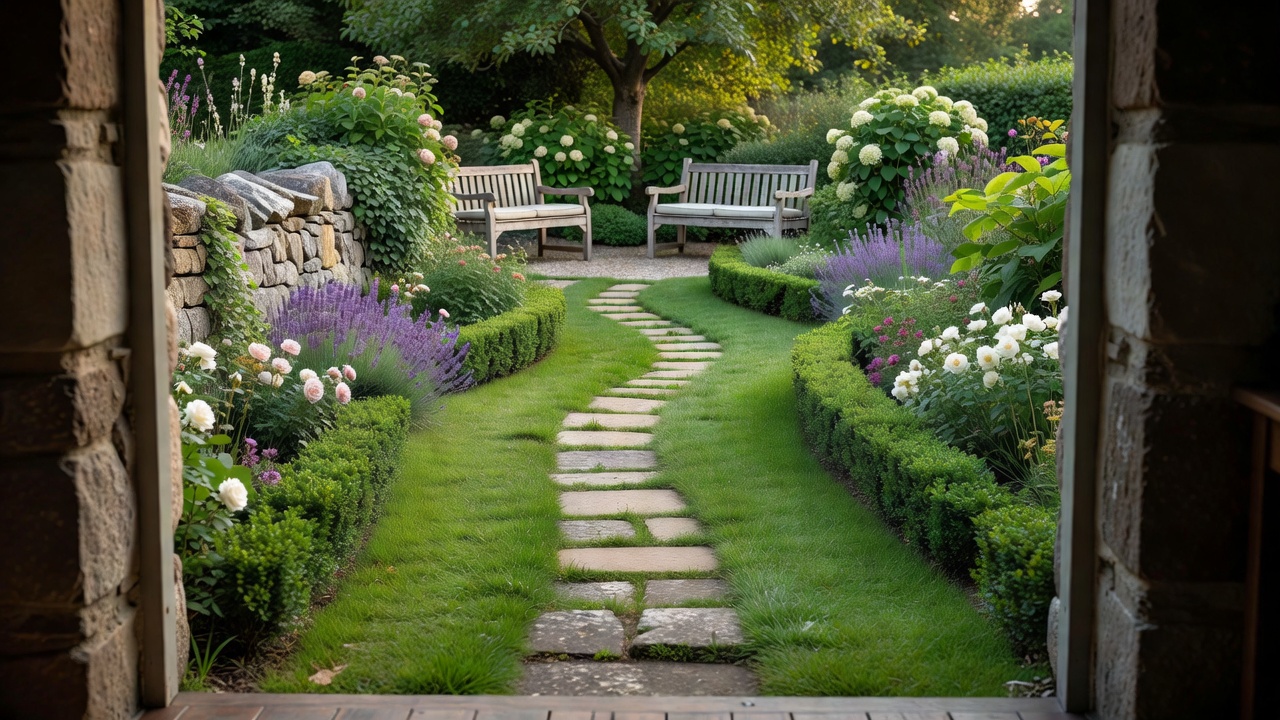
Choose a position you can repeat
Start with one broad view that explains the garden's layout. A doorway, stable paved area or identifiable path joint can provide a repeatable standing position. Record the camera height and direction in a note. If a tripod is useful, mark its location without creating a trip hazard. Do not rely on a plant or movable pot as your only reference: the object may not be there next time.
Keep a second position for a problem area, such as a damp corner or an awkward transition to the patio. Give each viewpoint a simple name. “Doorway toward rear boundary” is easier to reconstruct than “best garden view.” Include enough fixed context to align the images later. A beautiful close-up is valuable as a detail, but it cannot replace the wide record.
Hold the camera choices steady
Use the same lens or phone lens setting where possible. Switching to an ultra-wide view can make a small patio seem much larger, while moving a few steps backwards changes the relationship between foreground and background. Keep the horizon level and avoid dramatically tilting the camera. Save a reference image on the device so you can check the edges of the frame before taking the next photograph.
Light will never be identical, but you can reduce obvious distortions. Overcast conditions often make boundaries and planting easier to compare than strongly directional sunlight. If practical, return at a similar time of day. Record major differences rather than trying to hide them. A wet surface may look darker and richer than the same paving when dry; that is a condition, not necessarily a material change.
Keep a simple shooting sequence
Take the wide view first, then a middle-distance frame and any relevant details. Include unfinished areas and retained features, not just new work. During renovation, document stages only from a safe position agreed with whoever is responsible for the site. Do not step into excavations, climb unstable materials or interrupt work to recreate an angle. A missed frame is preferable to an unsafe one.
Repeat photographs after meaningful changes rather than creating an arbitrary daily obligation. Useful moments include the existing condition, a revised layout, installation, an early growing season and a later seasonal return. Add a photograph after a problem or repair as well. The purpose is to explain the garden's history, not to manufacture an uninterrupted story of improvement.
Write the caption while you remember
A practical caption records the date, viewpoint, weather, known work and uncertainties. Use a consistent date format in filenames, such as year-month-day, to keep files in order. Add the original filename to your notes so the image and context stay connected. Photographing a temporary note can help, but avoid placing private addresses or contact details in an image you might share.
Keep an untouched original and label edited copies. Modest exposure correction can help readability, but applying a gloomy treatment to the starting view and a warm, bright treatment to the later view is not a fair comparison. Disclose crops that remove context. If an image is a rendering, composite, staged scene or AI-generated illustration, label it as such rather than presenting it as documentary evidence.
Store a record, not just a highlight reel
Create one project folder with separate areas for originals, sharing copies and notes. Keep another copy on a separate device or trusted backup service. Camera metadata, often called EXIF data, may contain dates and location information, but it can be missing, changed or stripped during sharing. Treat it as helpful context, not independent proof of a project history.
Before publishing, check faces, house numbers, vehicle plates, reflections and neighbouring property. Obtain appropriate permissions for people and privately owned images. Remove location metadata from shared copies when privacy matters, while preserving your own original record securely. A good comparison respects the people around the garden as well as the facts visible inside it.
Use this caption pattern
Viewpoint: [fixed reference]. Photograph date: [known date]. Stage: [what changed]. Conditions: [light and weather]. Retained features: [visible items]. Unknowns: [cost, unseen work or elapsed time].
Prepare a question about your record